Sunday, 19 November 2017

Halima Cassell: Ceramic Artist

I enjoy looking at and into the clay sculptures by Cassell. The deep carving of the clay that she has mastered offer depth and light/shade as well as symmetry. They feel very satisfying somehow, in their symmetry and lack of fussy colour, relying on light and shade to give shape and tone to the forms

Image result for halima cassell


Helix  unglazed stoneware

The mid grey colour is spattered with tiny inclusions that offer texture as well as colour contrast all be it very subtle. The colour is not the theme and it doesn't distract from the form. The shape is a sphere with deep ravines of whirling pattern remind me of the unfurling of a flower centre or a leaf. The shape is femine and in her personal statement refers to these qualities being important in her work. A place where she always seems to end up.


Image result for halima cassell

Acapella

This form is made of bronze. The form is like a vase again with a signature form of deep curving ravines. The forms seem very tactile. The colour of the bronze is warm and though the geometry is "sharp" in its measurement and exactitude, the edges are not sharp looking, like a cutting edge, but slightly rounded off so that with a slight alteration it looks feminie rather than aggressive.


Artist Statement

I was interested to find the artists own statement about her work and like her descriptions of her influences and the desire to capture geometry in a way that is new. Her respect for the golden ratio and the strengths of the materials, plus a desire to push the materials and form to their limits. I felt like this gave me some things to think about in terms of printing processes which is where my interest currently lies.

http://www.halimacassell.com/artist/58bff8dfe5b41/Artist-Statement


John Pule: Artist, Poet, Writer

John Pule, a New Zealand artist and poet, moved into art from poetry in the late 1980's. He favours the tradition format of barkcloth art called hiapo, a freeform style which includes these delicate renditions of scenes from family, flora, fauna that have meaning to him. The image below offers a striking contrast between the bold vibrant blue amorphous shapes with the delicate trellis work of leaves and patterning. The tiny black ink drawings invite you to travel around the canvas, look closely and wonder.


Cantata (2006)  oil, ink and enamel on canvas

This image below is in a more traditional style of hiapo design, with scenes and elements segmented to form a kind of patch work whole. I think this is really well balanced with tiny elements and more dense patches of pattern. The colours are warm, reds and browns and so the pallette is warm and harmonious, reflecting the sense of strong affection the artist has for the process and the subject.


Image result for John Pule artist


The following is a link to an article which includes some biographical  information. the writer seems very in the corner of the artist. This artist is new to me and I realise the write up of his life has strongly influenced my perception of his work. I was drawn to the images first but feel a closer affinity to them having read the article. I admire his connection with traditional techniques and a respect for the method and artists that have gone before him. He also seems profoundly influenced by literature and poetry, such as Keats and so perhaps a romantic and idealized link to the past, but a respect for it, in this way, that I can connect with.

http://artasiapacific.com/Magazine/67/OdesOfARestlessSpiritJohnPule


Semiotics: Why is Semiotics important to advertising?

Definitions:

https://en.oxforddictionaries.com/definition/semiotics

Definition of semiotics in English:

  •  
  •  
  •  

semiotics

PLURAL NOUN

  • treated as singular The study of signs and symbols and their use or interpretation.

Origin

Late 19th century: from Greek sÄ“meiotikos ‘of signs’, from sÄ“meioun ‘interpret as a sign’.

Why is Semiotics important to advertising?
Adverts, whether in picture/still image form or televised short ads, use the opportunity to indicate a lot of information quickly as a "snap shot" of implied meaning. The signs and symbols are essential in order not to waste time explaining the value and potential usefulness of the elements of a product for sale or for recommendation. The immediacy that advertisers can adopt by using signs and  symbols related to gender, fashion, ethics, that are up to date and subconsciouslt or directly transmit meaning offer a powerful and often seductive "truth" about a product and so an effective advert can pressure people to buy or buy into a product or way of thinking/being. 

For example, this image below within an advert for the Little Green paint and paper company are using this advert to illustrate their new paint colour range. The inclusion of an elegant, beautiful, possibly talented woman wearing a dress in the colour of one of their new range is both striking and engaging. The "clever" and creative use of the boxes to the left to help form an interesting pictoral composition contrasting with the womans black hair and silver polished trumpet, shouts exhuberance. The advert suggesting maybe the only company to offer this elegant, life changing exhuberance is them!
The audience is probably middle class plus, from 30 onwards, given that the adverts are in Country House, a distinctly middle class publication, the image having a rich, expensive feel to it too. It works in as much as its a very striking and eye catching image. The message is not too blatant and so doesn't insult the audience too blatantly, and yet the old engredients of fantastically beautiful woman is right in the forefront, but because she's not holding a hoover or washing up, it may seem less sexist.

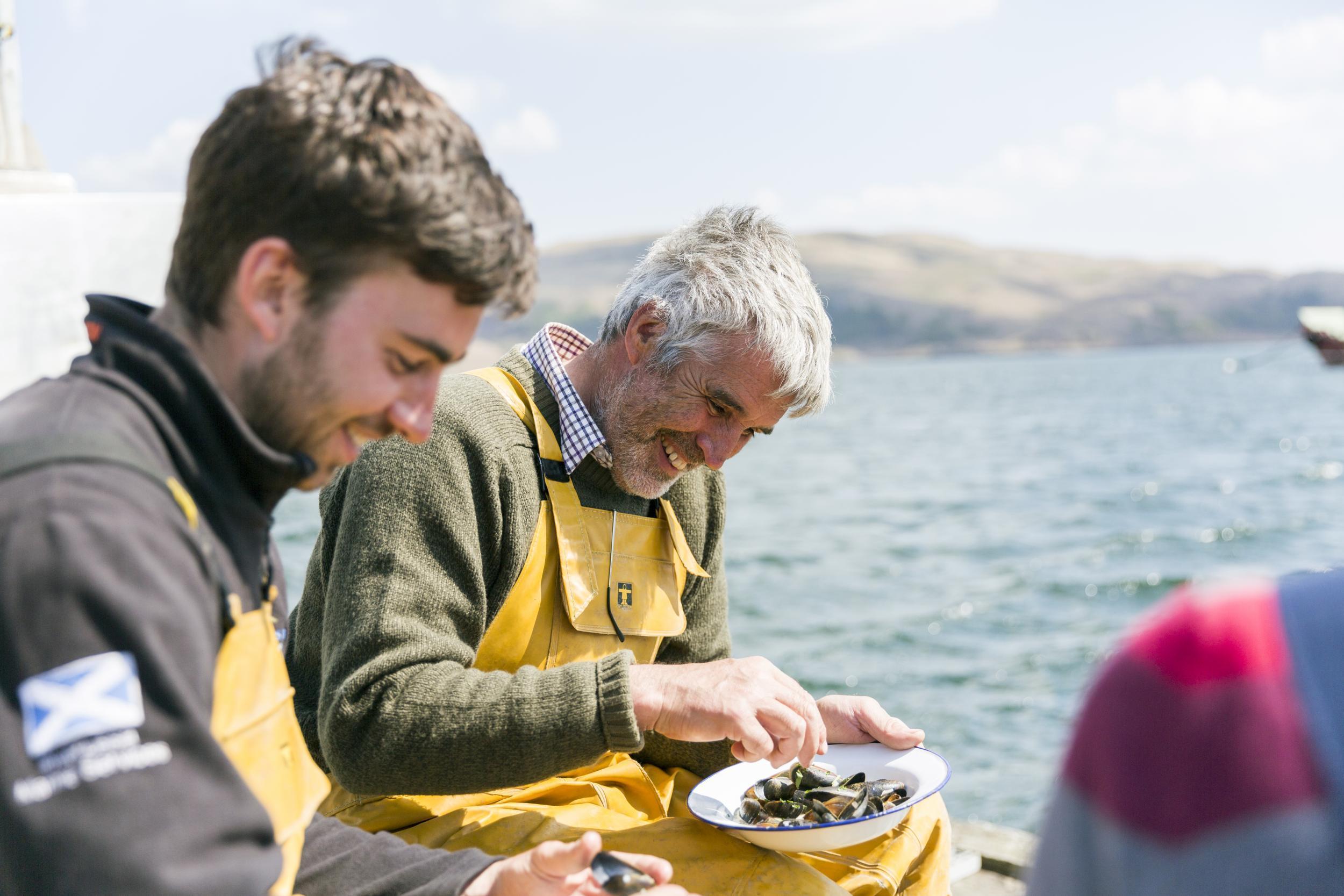
Another example: the image below features in an advert by Lidl commenting on its award as retailer of the year for their sustainably sourced seafood. The image plus the strap line suggest perhaps a fisherman and his son, eating their own catch. Safety, ethics, freshness and smiling faces enjoying the taste of the product are all transmitted quickly engaging the buyers sense of ethics and quality. It feels good to buy this product!  The audience is broad. Perhaps anyone who eats fish and will shop in Lidl. The image is of reasonably well turned out fishermen and so attempting to appeal to a broader range of consumers, and perhaps more middle class, given that Lidl started out appealing to people on lower income. I think it works, the appeal being as much about value for money as well as ethical sourcing, a good solid postmodern principle. 

Image result for lidl fish advert images


Chris Ofili: Artist. Social comment about injustice and racism

Image result for chris ofili

"No Woman No Cry" (1998) was painted as a tribute to Steven Lawrence, killed in a racist attack and dying as a consequence. The image shows a grieving woman, crying tears representing individual murders of black people. The customery plinths of dung represent the shitty side of life, and "deal" that black people often experience in the world. It's his comment on how black people are perceived and as a consequence are treated by individuals and systems.

I think the image is delicately rendered. The contrasting colours are both vibrant and full of life - the yellows and reds, contrasting with the delicate patterning of black pearls creating a mesh to see the image of the woman through. It looks like a container and may be making a comment on the imprisonment of the person for the value she can have to the world. I think its a comment on slavery as well as the individual experience of the murder of a womans son.

http://www.tate.org.uk/art/artworks/ofili-no-woman-no-cry-t07502

Ai Wei Wei: Artist and Film maker

In starting to try and understand the messages and principles of postmodernism, I was introduced to an artist, Ai Wei Wei, in class so looked more closely at his work. I was initially fascinated by an installation called Kippe (2006)


Related image

I was drawn to this piece out of all the images of his work in the reference: "Ai Wei Wei" (2016) pub: Royal Academy of Arts, London. From a visual perspective the wood pieces are pieced together so intricately to form what looks like a perfect dimension cuboid. The contrast of size, wood tone and decorative pieces is enthrawling. It seems like the past being packed away, forming its own transportable packing box.  The pieces are framents from dismantled temples of previous chinese dynasies. Its recycling but its also a comment on the current era and what these elements meant. I wanted to know what A Wei Wei was trying to say:

Ai's Kippe, too, was another work that stands out for its warmth, beauty, and personal qualities. Appearing to be an enormous pile of wood stacked for the fireplace or oven, it is packed perfectly tightly to form a flawless block. It incorporates architectural ornaments, mere splinters, and slices from cross-cuts of the beautiful ironwood trees. It forms a wall almost like  an oven glowing a steady heat. Who would need anything the woodpile itself does not give?

The notes connect the work to Ai's memories not only of the family's woodpile, but of the village basketball hoop (the uprights) and parallel bars, which are easily read into the structure. Is the success of this piece—its accessibility to the sensoriums and imaginations of others—a result of its genesis in Ai's lived experience? http://starr-review.blogspot.co.uk/2013/05/ai-weiweis-challenges-and-questions.html

 Then there are the installations from piles of reclaimed wood, like “Kippe,” that get their strength from knowing that each piece of the sculptures was once part of a Qing Dynasty temple that was dismantled to make way for the new buildings of China. The most interesting of these temple pieces in DC was actually not in the Hirshhorn, but in another Smithsonian institution, the Sackler Gallery, where the wooden pieces were rebuilt into a sort of freeform memory of a temple, a more powerful statement than the clunkier wooden sculptures in According to What? that lost the delicate nature of the temple details in their bulk. https://hyperallergic.com/65829/the-visual-memory-of-ai-weiweis-survey-at-the-hirshhorn-museum/

In looking at his work generally I came across a trailer for a film he has made and is yet to be made available for full viewing. He is a man who is passionate about justice and injustice and uses his art, whether sculpture, installation or film-making to draw attention, bluntly and bravely, about these human injustices.

https://www.theguardian.com/film/2017/aug/31/human-flow-review-ai-weiwei-refugee-crisis

Post Modern Art

Definition:

In art, postmodernism was specifically a reaction against modernism which had dominated art theory and practice since the beginning of the twentieth century. The term postmodernism is also widely used to describe challenges and changes to established structures and belief systems that took place in Western society and culture from the 1960s onwards.

The term was first used around 1970. As an art movement postmodernism to some extent defies definition – as there is no one postmodern style or theory on which it is hinged. It embraces many different approaches to art making, and may be said to begin with pop art in the 1960s and to embrace much of what followed including conceptual artneo-expressionismfeminist art, and the Young British Artists of the 1990s.

(http://www.tate.org.uk/art/art-terms/p/postmodernism)


Transition from Modern Art to Postmodern Art

In searching for a way to understand the difference between modernism and post modernism,  I found this helpful description on the Tate Britain website, as a useful starting point:
Postmodernism was, in some ways, a reaction against modernism. Modernism was generally based on idealism and a utopian vision of human life and society and a belief in progress. It assumed that certain ultimate universal principles or truths such as those formulated by religion or science could be used to understand or explain reality. Modernist artists experimented with form, technique and processes rather than focusing on subjects, believing they could find a way of purely reflecting the modern world.
While modernism was based on idealism and reason, postmodernism was born of scepticism and a suspicion of reason. It challenged the notion that there are universal certainties or truths. Postmodern art drew on philosophy of the mid to late twentieth century, and advocated that individual experience and interpretation of our experience was more concrete than abstract principles. While the modernists championed clarity and simplicity; postmodernism embraced complex and often contradictory layers of meaning.
(http://www.tate.org.uk/art/art-terms/p/postmodernism)
In terms of art styles, it was thought that modernist artists were becoming ever more reductive and abstraction focused. Tim Woods (1999) suggested postmodernism is a reaction to being "bored with the incessant drive for ever increasing minimalism and abstraction, post modernism was part of a re-introduction of ornament, morals, allegories and decoration into art." (Beginning Post-Modernism, pub Glasgow, Bell and Bain Ltd). In reference to "morals",  there is a greater "use" of art as a platform to comment socially and politically about moral issues. I would argue that moral issues were very directly commented on by modernist artists, particularly Dada-ist artists such as Hannah Hock making comment about oppression, fragmentation as a consequence of the political European shifts and relationships with power struggle that individual countries and leaders were having.
I am still in love with the early/mid 20th century art and artists!! On my journey into studying post modernism, I will hang onto the learning and respect I developed for modernism and it's pioneers.

I am also excited to be learning something new and to explore different styles and techniques, finding out what my contempories are saying through their art. I think that is part of my resistance in embracing postmodernism fully. I notice that I'm also suspicious. Established postmodernist artists are of my own generation and there's a sense of therefore being a part of something that I should feel, understand, be implicit with and naturally connect with. Perhaps its a form of sibling rivalry!!!!!!! I say that tongue in cheek but at the same time it is much easier to respect and explore a phase of history that feels ended, complete and distant. Like talking about your grandparents has a different sense than talking about your brother. Their is a current dynamic that is still lively and alive, shifting day to day and not concluded. It's great, but messy.