Monday, 5 March 2018

Post Modern Fashion

Vivienne Westwood

Looking at the work of the most famous post modern fashion designer and stylist, I have selected this set of images below that includes the designer herself in the centre pic. My first impression is that she is dressing with no regard for the social norms of traditional "age" centred style. She is independent and self promoting but without arrogance. She is entirely herself, a post modern ethos? She is layering her garments and wearing very striking footwear and socks over ribbed tights. My granny would condone the layers and probably appalled at the T shirt and dyed hair but she offers a permission for individuality and kicks against the social and fashion norms in true punk style, whilst creating a fashion trend that others follow, at the same time. The paradox of fashion. The other 2 images are equally striking but although credited as her work, they don't look like her style. They are flowing and feminine whilst still retaining a hard edge.


Image result for vivienne westwood fashion images


I also like this article and exhibition review, with direct references to the germs of the post modern movement in fashion and the impact. The support of individuality in fashion across all genders.

The V&A’s exhibition ‘Postmodernism: Style and the Subversive 1970-1990’ offers a pop of colour with its run through the wintery months until January 2012.

https://www.notjustalabel.com/editorial/postmodernism-style-subversive

Saturday, 3 March 2018

Damien Hirst: Post Modern Artist - Sharks, Spots and Butterflies

I have an ambivalence about the work of Damien Hirst. I don't know if it's just that I can't connect with his artwork and they don't speak directly to me or if it comes from somewhere else. His animals in formaldehyde, having explored them more, do present an interesting issue.  The impossibility of death in the mind of someone living, is an interesting exploration of mortality in a very direct way and yet I still don't feel impacted by it. It doesn't shock or repulse me but has a little more meaning now I understand the concept behind these works. Equally, despite his spot designs being a marvellous play with colour and pattern, still make me cross, I realise!!!!! I think it's the knowledge that predominantly the technical production is undertaken by others. This is common practice and I love the work of artists like Tony Cragg who also employs technicians to assist with construction. This feeling presents a common dilemma of who's art it is. Obviously the concepts belong to Hirst and perhaps that is all that should matter. It feels a grey area still for me.

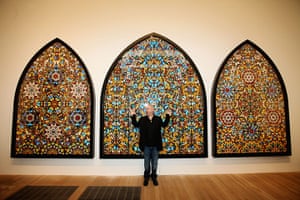
I have, however, found this image of this tryptych: "Doorways to the Kingdom of Heaven" I do like the middle eastern patterning and the arch shapes. It is a piece I'd like to see in a gallery setting to appreciate the colours and the intricate detail. This work using butterflies is mesmerising, as are a number of his other butterfly works. Perhaps I'm just an old fashioned appreciator of beauty and so struggle with the formaldehyde works! 


Damien Hirst: Damien Hirst poses infront of 'Doorways to the Kingdom of Heaven'


Daniel Mountford: Graphic Designer - Double exposure photography

Daniel Mountford studies graphic design and became very interested in the effects acchieved with multiple exposure photography. Most of his images are portraiture with animal or architectural elements. They have an other worldly and ethereal quality. He made a series of portraits called "The World Inside of Us". "Dan describes this series as “a visual journey through our minds by calm and tidy means which the reality of everyday life does not show.” He explores the use of double exposure in his photographs, successfully isolating parts of an image in camera with no help from our friend Photoshop. His images are captivating with their thoughtful execution and composition." (https://www.grainedit.com/2011/03/03/dan-mountford/)

I was particularly drawn to this image:

Dan Mountford

The monochrome pallet adds to the atmosphere of mystery to this image using the texture of planting for the woman's hair and hard paving to signify the shoulder. The architectural elements in the centre speak about the internal landscape of the mind and thought processes and the very geometric graph identifying the profile adds another interesting element to the image and makes me think about the synaptic neural pathways of experiencing and memory,

An additional review of Mountford's work:
https://www.thephoblographer.com/2015/12/05/daniel-mountfords-double-exposures/

DISCUSSION: What are the Main Differences between Modernism and Post Modernism?

Modernism was stimulated by changes in the industrial and political world. Industrialization was a catalyst for huge change in the way of life for those living in the Western world. Types of work change as factories evolved, technology and invention accelerated, transport changed, evolved and increased the ways people could travel and with greater speed allowing faster and more timely travel and communication. A reaction to WW1 stimulated a desire for a more Utopian way of living and so a rejection of the previous traditions and some values. Modernism can now be seen as a distinct phase of culture change that was fading or overtaken by new ways of thinking, perceiving, and living in the world. Modernism finally ended at the end of the 1960's although the seeds of Post Modernism were already germinating 10 years prior.

Post Modernism is difficult to define neatly! It is a change in attitude toward life and living, toward other people and groups, in as much as eqaulity and fairness across the world was seen as the way forward. The consequences in art forms are that art was being made to establish this new thinking and characterised by Irony, political statements about emancipation, a cynacism toward and a challenge of the establishment. The fine art quality was often seen as part of that establishment and the energetic kicking against it produced work that wasn't easily understood when applying the "old standards" of assessing art, that being very much part of the statement.


A curator from the Hirshhorn Museum explains how art historians define the two classifications

https://www.smithsonianmag.com/arts-culture/ask-an-expert-what-is-the-difference-between-modern-and-postmodern-art-87883230/