I find the work of Anish Kapoor stunning in its simplicity of line and limited but strong or no colour palette. My favourite piece is a sculpture made from alabaster and cut into, creating ever reducing windows. The outer part of the sculpture has the raw surface of the untreated rock whilst the polished and cut forms are perfectly engineered, with straight, unatural lines making the manmade and the natural form a thing of intriguing beauty.
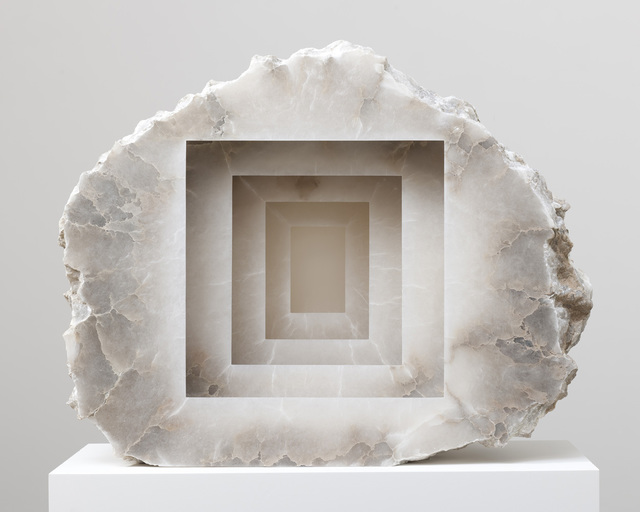
Blind 2013 (Alabaster)

This impossible looking sculpture looks like it is made purely from pigment, with the remaining red dust on the floor suggesting its material. The simple but beautifully curving lines that come to a point suggest an unfurling leaf, a sharks fin under immense pressure! or an exposed hook. The colour is the reddest red and curated in a blank space where it seems to burst through the floor is impactful and alluring.
https://www.lissongallery.com/artists/anish-kapoor
"Anish Kapoor is one of the most influential sculptors of his generation. Perhaps most famous for public sculptures that are both adventures in form and feats of engineering, he manoeuvres between vastly different scales, across numerous series of work. Immense PVC skins, stretched or deflated; concave or convex mirrors whose reflections attract and swallow the viewer; recesses carved in stone and pigmented so as to disappear: these voids and protrusions summon up deep-felt metaphysical polarities of presence and absence, concealment and revelation. Forms turn themselves inside out, womb-like, and materials are not painted but impregnated with colour, as if to negate the idea of an outer surface, inviting the viewer to the inner reaches of the imagination. Kapoor’s geometric forms from the early 1980s, for example, rise up from the floor and appear to be made of pure pigment, while the viscous, blood-red wax sculptures from the last ten years – kinetic and self-generating – ravage their own surfaces and explode the quiet of the gallery environment. There are resonances with mythologies of the ancient world – Indian, Egyptian, Greek and Roman – and with modern times, where 20th century events loom large."

No comments:
Post a Comment