He was born in Britain but grew up in Lagos, Nigeria. His father was a lawyer so would have been considered coming from a rich family in this culture. He returned to Britain to study A levels and then art. The cultural influences in his early life can be seen in the art he designs, and I'm guessing deeply informs his beliefs about race, culture and class.
Biography: http://www.yinkashonibarembe.com/biography/
He uses many hard and soft materials in his artwork and is particularly famous for using african batik cloth, mass produced in Holland.
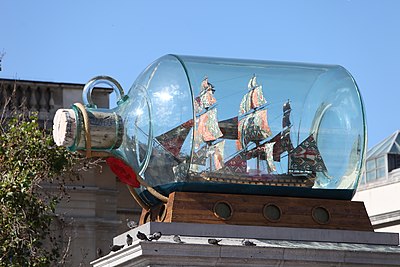
Nelson's Ship in a Bottle, during its occupancy on the forth plinth in Trafalgar Square.
https://www.artfund.org/supporting-museums/art-weve-helped-buy/artwork/11795/nelsons-ship-in-a-bottle
"The work is a scaled-down replica of HMS Victory, the ship captained by Nelson. It was commissioned by the Greater London Authority in 2009 for the fourth plinth in Trafalgar Square, where it was displayed from May 2010 to January 2012. The only significant departure from the historical Victory is the use of richly patterned ‘Dutch Wax’ fabric (a trademark of the artist’s work) for the 37 sails. The fabric is commonly associated with African dress and symbolic of African identity and independence. Tying together historical and global threads, the work considers the legacy of British colonialism and its expansion in trade and Empire, made possible through the freedom of the seas and new trade routes that Nelson’s victory provided. "
One of Shinobares most notable works is an installation : "Gallantry and Criminal Conversation (Parassol)" (2002). It represents the experience of 'The Grand Tour', from a 21st Century perspective, the Grand Tour being a fashion for young socialites to tour europe and come of age. It seems that exploring sexuality and sexual experience was a profound element in the experience. The installation draws attention to the public and private face of this grand tour experience.
https://africa.si.edu/exhibits/shonibare/gallantry.html


No comments:
Post a Comment